Sodium bicarbonate: what it does, and who it is actually for
Sodium bicarbonate is bicarbonate of soda, an ordinary and cheap ingredient, and it is one of the very few supplements with good evidence behind it for hard athletic efforts. It is also one of the easiest to get wrong. Here is what it does, who it helps, and why the stomach is the real catch.
What it does
When you work very hard, your muscles produce hydrogen ions, and as they build up the muscle becomes more acidic. That build-up is one of the things that contributes to the burn and to fatigue. Bicarbonate is a buffer: taken ahead of time, it raises the amount of bicarbonate in your blood, so more of that acid can be mopped up while you are working.
What the evidence says
The 2018 International Olympic Committee consensus statement on supplements lists buffering agents, which includes bicarbonate, among the small group with good evidence of benefit. A 2021 position stand from the International Society of Sports Nutrition goes into the detail:
- it improves performance in high-intensity efforts lasting roughly 30 seconds to 12 minutes
- the improvements are small but real: around 1% to 3% over middle-distance running, rowing and swimming, and around 2% in cycling time trials
- it has also been shown to help muscular endurance and repeated bouts of hard work, including in combat sports
- it does not help very short efforts of under about 30 seconds, or long steady efforts of 20 minutes or more
Two honest caveats come with that. Responses vary a lot from person to person, and the position stand notes that part of the effect may be down to expectation rather than chemistry.
Who it is for, and who it is not
It suits events built from repeated hard efforts of around one to ten minutes: combat sports, rowing, middle-distance work, interval-style racing and some hybrid events. It does nothing for a long steady effort such as a marathon, and it has no place in a single maximal lift.
That is how it is used in Core Protocol's protocols: it appears only for events that call for it, and it is left out of long steady events where it would do nothing.
The dose, and why the stomach is the catch
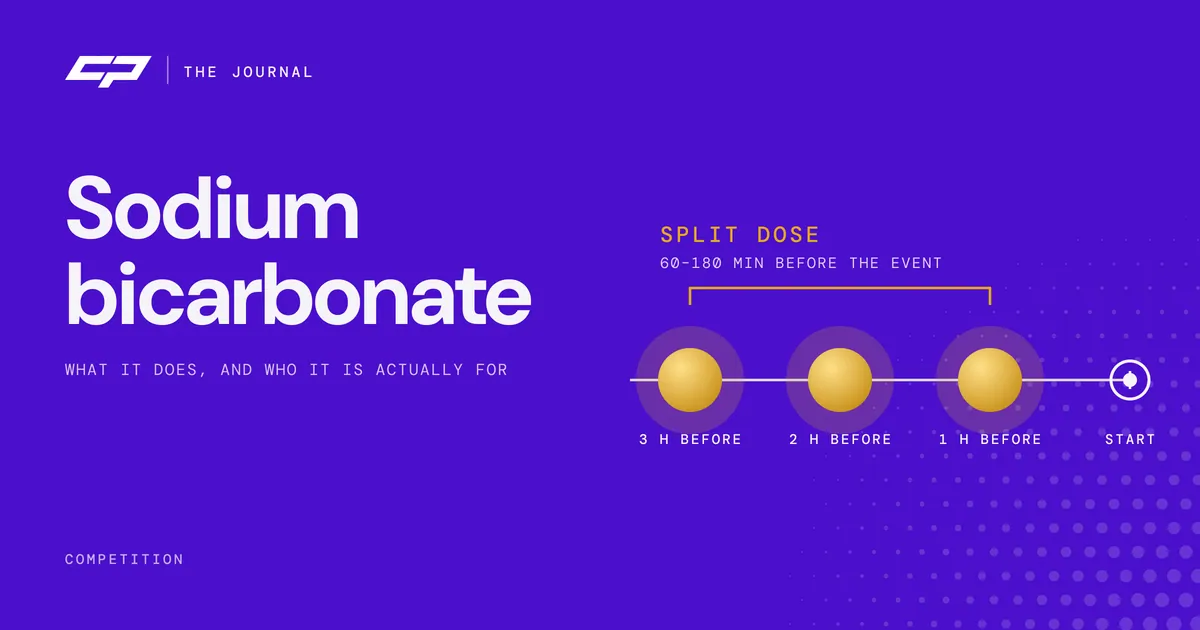
The research settles on about 0.3 grams per kilogram of body weight, taken 60 to 180 minutes before the effort. 0.2 g/kg is about the lowest dose that works. Going up to 0.4 or 0.5 g/kg does not add benefit and makes side effects worse. The IOC statement allows the same total to be split across a window of 30 to 180 minutes beforehand. Our protocols use 300 mg/kg of body weight, split, 60 to 180 minutes before the event.
For a 75 kg athlete, 0.3 g/kg is 22.5 g. When that reaches stomach acid it releases gas, and the common side effects are bloating, nausea, vomiting and abdominal pain. They vary between people, and even between occasions for the same person. Things that help:
- split the dose rather than taking it all at once
- take it with a carbohydrate-rich meal
- allow more time, up to about three hours before
- consider enteric-coated capsules, which are designed to release lower down
If you do get symptoms, they can undo the benefit: in one study the gain showed up only in the athletes who had no side effects.
It is a large dose of sodium
Sodium bicarbonate is about 27% sodium by weight. A 22.5 g dose therefore contains roughly 6 g of sodium, the sodium in about 15 g of salt. The NHS advises adults to have no more than 6 g of salt a day. This is not the same job as the sodium in an electrolyte drink, which replaces what you lose in sweat, as we cover in electrolytes: what to check on the label. With bicarbonate the sodium simply comes with the buffer.
That is why it needs caution if you have high blood pressure or heart problems, should be avoided if you have kidney impairment, and should be discussed with a doctor first if you are on a sodium-restricted diet or take medicines that affect fluid balance.
Never try it for the first time on the day
Because tolerance is so individual, the plan matters more than the product. Trial the dose in training, well ahead of the event, with the same timing and the same food you intend to use on the day. In the week before, settle the split and the timing. If it upsets your stomach, drop it: a compound that costs you a bad ten minutes is not a benefit, whatever the evidence says on average.
If you are making weight
Bicarbonate and creatine belong after the weigh-in, not before it. If you are cutting weight, reintroduce them only once you have weighed in, alongside rehydration and a carbohydrate reload. Rapid dehydration carries real cardiovascular and performance risk, so work with a coach and, where possible, a clinician. We do not sell cutting aids.
Where this leaves you
Sodium bicarbonate is a narrow tool. It is worth considering for a specific kind of event, at a dose scaled to your body weight, trialled in training and handled with care around sodium. A protocol treats it that way: included when the event calls for it, left out when it would do nothing, and never a daily habit.
Sources
- International Society of Sports Nutrition position stand: sodium bicarbonate and exercise performance, Journal of the International Society of Sports Nutrition, 2021: pmc.ncbi.nlm.nih.gov/articles/PMC8427947
- IOC consensus statement: dietary supplements and the high-performance athlete, 2018: pubmed.ncbi.nlm.nih.gov/29540367
- NHS, salt in your diet: nhs.uk