Creatine: what the evidence says, and how to use it
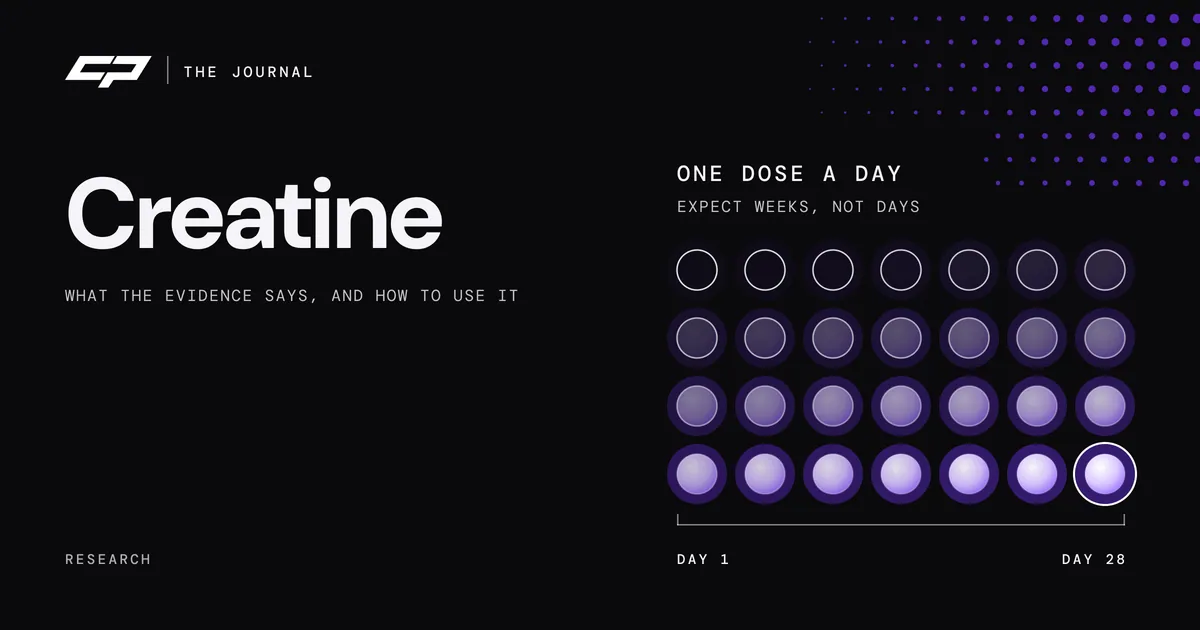
Creatine is a natural compound your muscles use for short bursts of energy, and creatine monohydrate is one of the few supplements the International Olympic Committee says has good evidence of benefit. Taken daily alongside resistance training, it gives small average gains in strength, power and lean mass. The catches: it builds up over weeks, people respond differently, and the evidence does not stretch to bigger claims such as better brain function.
What it is and what it does
Your body makes some creatine, and a normal diet supplies 1 to 2 g a day. About 95% is held in skeletal muscle, around two thirds of it as phosphocreatine, which helps rebuild ATP, the molecule that powers muscle contraction, during short, maximal efforts.
On a normal diet, muscle stores are roughly 60% to 80% full. Supplementing raises them by about 20% to 40%. Vegetarians tend to start lower, so may gain more.
What the evidence says
The 2018 IOC consensus statement lists creatine among the few supplements with good evidence of benefit, alongside caffeine, buffering agents and nitrate. The International Society of Sports Nutrition (ISSN) position stand calls it the most effective supplement available for high-intensity exercise capacity and lean mass during training. The numbers are more modest than that sounds:
- Strength and power. A 2025 meta-analysis of 69 studies and 1,937 people found that creatine plus training beat placebo plus training by 1.43 kg in bench or chest press strength, 5.64 kg in squat strength, 1.48 cm in vertical jump and 47.81 W in Wingate peak power. Handgrip and leg press strength showed no significant difference. The authors call the gains small.
- Body composition. A 2024 meta-analysis of 12 trials in adults under 50 found that adding creatine to resistance training gave 1.14 kg more lean mass (95% confidence interval 0.69 to 1.59) and 0.73 kg less fat mass. Lean mass counts water as well as muscle tissue, and creatine retains some water, so it is not a pure measure of new muscle.
- Regulators. In 2012 the EU authorised a claim, based on a 2011 EFSA opinion, that creatine increases physical performance in successive bursts of short-term, high-intensity exercise, at 3 g a day, for adults doing high-intensity exercise. A 2017 claim covers adults over 55 who do regular resistance training.
- Not shown. In 2024 EFSA concluded that a cause-and-effect link between creatine and better cognitive function had not been established.
Responses vary: the IOC notes that genetics, the gut microbiome and habitual diet all affect them.
Who it is for, and who it is not
Creatine suits short, hard efforts: lifting, sprinting, jumping, repeated intervals and power-endurance events. The evidence rests on those efforts, and the EU claim is limited to them.
The evidence is thinner for two groups. In the 2025 meta-analysis, males gained significantly on squat, leg press and vertical jump and females did not, though few trials included women, and a 2021 ISSN review describes accumulating evidence of benefit for them. For older adults, EFSA accepted a benefit alongside resistance training in over-55s, but the meta-analysis found no significant gains for the lifts it measured.
The dose and timing
- Daily dose. ISSN guidance is 3 to 5 g a day, or about 0.1 g per kilogram of body weight. Larger athletes may need 5 to 10 g to maintain their stores.
- Time to work. In a classic study, 3 g a day for 28 days raised muscle creatine as much (around 20%) as 20 g a day for six days. Expect weeks, not days.
- Loading. The faster route is about 0.3 g/kg a day, around 20 g split into four doses, for 5 to 7 days. It is not required, and single servings above 10 g may cause diarrhoea.
- Timing. Consistent daily intake matters more than when you take it. If you stop, stores take 4 to 6 weeks to return to baseline.
Core Protocol uses 5 g of micronised creatine monohydrate a day, at any time, with no loading. That is the top of the usual range, above the 3 g in the EU claim, and a flat dose rather than one scaled to body weight. Starting a few days before an event will do little.
Safety: who should take advice first
- Track record. Drawing on over 1,000 studies, the ISSN found no compelling evidence of harm at up to 30 g a day for 5 years. Weight gain is the only consistently reported side effect.
- Body weight. A loading phase typically adds 1 to 3 kg, mostly water. That matters in weight-class sport, so for anyone making weight we hold creatine back until after the weigh-in (see sodium bicarbonate: what it does, and who it is actually for).
- Kidneys. The body breaks creatine down to creatinine, the marker doctors use to estimate kidney function, so a blood test can read higher while the kidneys are fine. A 2025 review of 21 studies found a modest, transient rise in serum creatinine and no significant change in glomerular filtration rate, though long-term data are sparse. Tell whoever reads your blood tests that you take creatine, and speak to your GP first if you have a kidney condition.
- Myths. The 2021 ISSN review found no support for claims that creatine causes dehydration or cramps. One rugby study found a rise in the hormone DHT, which has not been replicated, and no study has reported hair loss in humans.
- Pregnancy and breastfeeding. Animal data are reassuring, but the ISSN's 2024 review found no well-designed human trials. Ask your midwife or GP first.
How it fits in a protocol
In Core Protocol, creatine is a daily training compound rather than a race-day one. It sits in the training pouch. For an event we do not load it: you keep your usual dose through race week and on the day, because the benefit comes from full stores. It appears in race-day protocols for repeated or maximal efforts, such as lifting, combat sports, Hyrox and CrossFit, and not for long steady events like marathons.
The ISSN's 2024 review found short-term creatine and caffeine (under 5 mg/kg a day) unlikely to work against each other. We cover caffeine in caffeine and L-theanine: what is proven, and what is not.
Where this leaves you
Creatine is one of the few supplements with strong evidence and a long safety record, though the gains are small and build over weeks. It is worth considering if you train hard for strength or power: 3 to 5 g a day, taken consistently, started well before any event.
Sources
- ISSN position stand: safety and efficacy of creatine supplementation in exercise, sport, and medicine, Journal of the International Society of Sports Nutrition, 2017: pmc.ncbi.nlm.nih.gov/articles/PMC5469049
- Common questions and misconceptions about creatine supplementation, Journal of the International Society of Sports Nutrition, 2021: pmc.ncbi.nlm.nih.gov/articles/PMC7871530
- Part II. Common questions and misconceptions about creatine supplementation, Journal of the International Society of Sports Nutrition, 2024: pmc.ncbi.nlm.nih.gov/articles/PMC11703406
- Effects of creatine supplementation on upper- and lower-body strength and power: a systematic review and meta-analysis, Nutrients, 2025: pmc.ncbi.nlm.nih.gov/articles/PMC12430374
- Creatine supplementation and resistance training-based changes to body composition: a systematic review and meta-analysis, Journal of Strength and Conditioning Research, 2024: pubmed.ncbi.nlm.nih.gov/39074168
- Effect of creatine supplementation on kidney function: a systematic review and meta-analysis, BMC Nephrology, 2025: pmc.ncbi.nlm.nih.gov/articles/PMC12590749
- IOC consensus statement: dietary supplements and the high-performance athlete, British Journal of Sports Medicine, 2018: pubmed.ncbi.nlm.nih.gov/29540367
- Commission Regulation (EU) No 432/2012 (creatine claim, from EFSA Journal 2011;9(7):2303): eur-lex.europa.eu/eli/reg/2012/432/oj
- Commission Implementing Regulation (EU) 2017/672 (creatine claim, adults over 55): legislation.gov.uk/eur/2017/672
- Creatine and improvement in cognitive function: evaluation of a health claim, EFSA Journal, 2024: pmc.ncbi.nlm.nih.gov/articles/PMC11574456