Why static stacks fail serious athletes
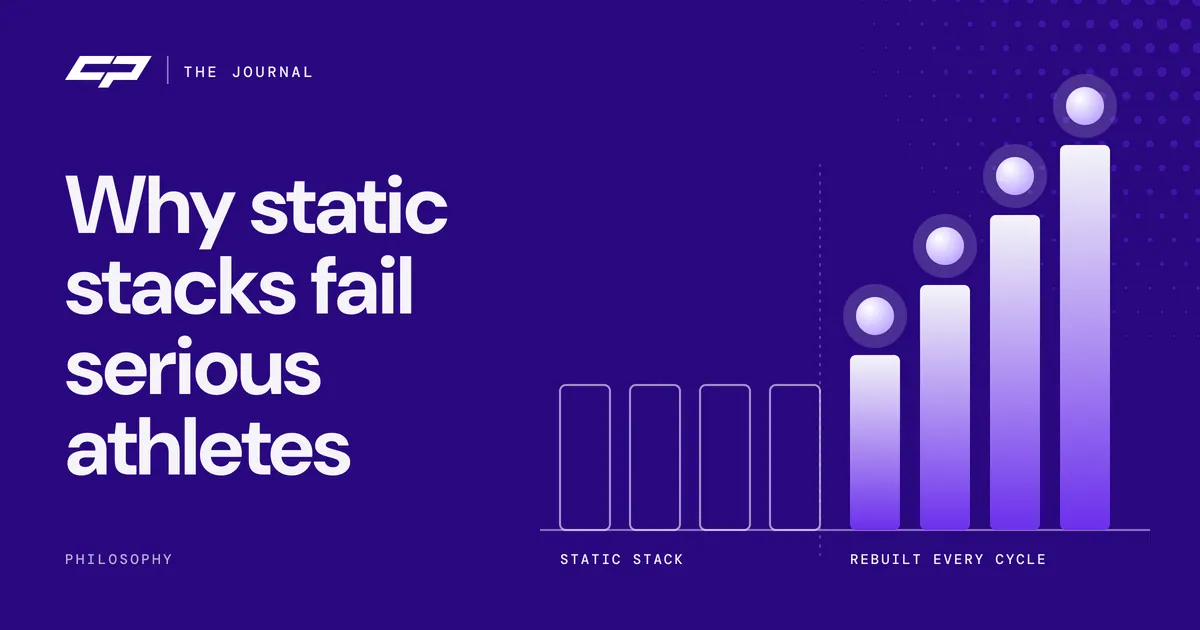
Your body changes. Your training changes. Your competition calendar changes. A stack built once and left alone is a one-time test, and it is wrong the moment your life moves.
A stack is a snapshot
Most supplement stacks are built the way a shopping list is: pick the products with the best reputations, add them up, and take them every day for as long as the tub lasts. That treats the person taking them as fixed. Serious athletes are the opposite. Training load builds through a block and drops in a deload. Goals shift from putting on size to getting lean for a weigh-in. A competition date appears on the calendar and everything is reordered around it.
None of that shows up in a list of products bought last spring.
When you take it matters as much as what you take
A flat instruction to "take everything with breakfast" ignores how a training day really works. Some things are taken before a session, some during it, some in the evening, and some are simply daily staples. If you train twice in a day, the pre-session and during-session items belong to each session, not to the day as a whole. A schedule that does not know how many times you train cannot get this right, and neither can a reminder built on top of it.
Stacking by hand double-counts
Ingredients overlap more than people expect. Magnesium, zinc, vitamin B6 and caffeine all turn up in more than one product, and the totals only mean something once you add them up across everything you take. Each of those has a sensible upper limit. When a stack is assembled product by product, nobody is adding up the ingredients, so nobody notices when two "different" products are quietly topping up the same thing. A protocol should manage the ingredient totals, not the product labels.
A protocol reviews itself
The answer to a changing athlete is not a better static list. It is a process: ask the right questions up front, build a stack from the answers, then come back on a regular cycle and ask again. If your training, goals or events have moved, the stack moves with them. If nothing has changed, it stays put. At Core Protocol that is a 28-day cycle, and a rebuild is simply the point where the protocol checks whether it is still the right one.
What this is not
It is not a cure-all, and it is not medical advice. A supplement protocol is the last small percentage on top of consistent training, food and sleep, and it should never replace advice from a clinician. If you have a medical condition, take medication, are pregnant or trying to conceive, or are unsure about anything you take, speak to a doctor or registered dietitian first.
The point is a modest one. If your training is not static, the way you supplement it should not be either.